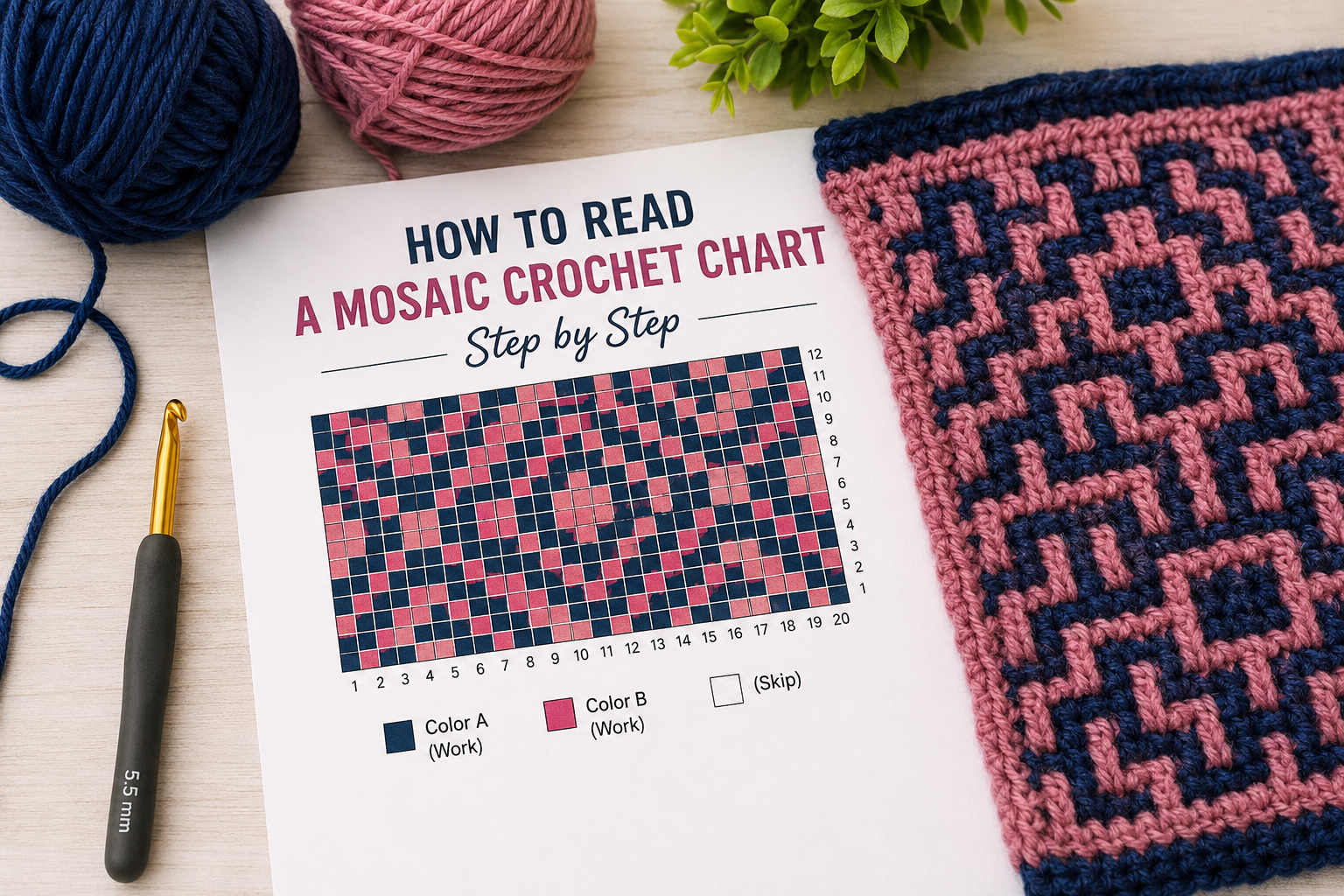
A mosaic crochet chart can look like a confusing grid of squares at first. Once you know what each part means, though, it becomes the easiest way to follow a pattern, because you can see the whole design at once.
This guide walks you through reading a mosaic crochet chart step by step, explains the common symbols, and covers the mistakes beginners make most often. If you are completely new to the technique, read What Is Mosaic Crochet? A Beginner's Guide first.
What Is a Mosaic Crochet Chart?
A mosaic crochet chart is a grid that represents your fabric. Each square is one stitch and each row of squares is one row (or one pair of rows) of crochet. The squares are colored in your two yarn colors, and some contain a symbol, usually an X or a dot, to show where to work the long drop-down stitch that creates the design.
Charts are popular because they are compact and visual: you can compare your work to the picture and spot a misplaced stitch immediately.
The Parts of a Mosaic Crochet Chart
- Row numbers: printed along the side of the chart. They tell you which row you're on and which side it starts from.
- Edge color: the color of the first square (or the edge column) in a row tells you which yarn to use for that row.
- Plain squares: work the standard stitch for your technique, usually a single crochet.
- Marked squares (X or dot): work the drop-down stitch, usually a double crochet into a lower row.
- Edge or border stitches: often shown as extra columns at each side that stay the same every row.
- Repeat lines: some charts show a section to repeat across the row, marked with bold lines or brackets.
- Key: always read the pattern's key first, because symbols vary between designers.
How to Read a Mosaic Crochet Chart: Step by Step
Step 1: Read the key and identify the technique
Check whether your pattern is overlay or inset mosaic, and note what each symbol means. This decides which stitches you use and how many crochet rows each chart row represents.
Step 2: Make your foundation
Count the squares across the bottom row of the chart, including edge stitches, or use the stitch count given in the pattern. Make your foundation chain and first row exactly as the pattern describes.
Step 3: Start at the bottom and work upward
Mosaic charts are read from the bottom row to the top, just as your fabric grows. Row 1 is at the bottom.
Step 4: Read each row in the direction you crochet
For right-handed crocheters, right-side rows are read from right to left. In overlay mosaic, you usually work every row from the right side, so every chart row is read right to left. In inset mosaic, the wrong-side rows travel back left to right, but they normally repeat the stitches of the row before. Left-handed crocheters read in the opposite direction.
Step 5: Check the color for the row
Look at the edge square or the row number color to see which yarn you need. In overlay mosaic, the color usually changes every row. In inset mosaic, you typically work two rows in each color.
Step 6: Work plain squares and marked squares
Move across the row square by square:
- Plain square: work your basic stitch into the row below (in overlay mosaic, typically a single crochet in the back loop).
- Marked square: work the drop-down stitch. In overlay mosaic, this is usually a double crochet into the front loop of the stitch two rows below. In inset mosaic, it is a double crochet into the skipped stitch below, in front of the chain space.
The long stitch pulls the color from the lower row up to the surface, which is how the design appears.
Step 7: Count, mark and repeat
At the end of each row, count your stitches and tick the row off on your printed chart. Then move up to the next row and repeat.
Overlay vs Inset Mosaic Charts at a Glance
- Overlay mosaic: one crochet row per chart row, worked from the right side, color usually changes each row, drop-down stitch is a dc in the front loop two rows below.
- Inset mosaic: one chart row often equals two crochet rows (right side and wrong side), uses chain spaces, color changes every two rows.
Always follow your own pattern's instructions if they differ from this summary.
Common Mistakes When Reading Mosaic Crochet Charts
- Losing your place. Use a ruler, sticky note or highlighter under the current row.
- Reading in the wrong direction. Double-check where each row starts before you begin it.
- Working into the wrong loop. In overlay mosaic, back-loop and front-loop stitches matter; working into both loops can close the spaces you need later.
- Missing a stitch. One missing stitch shifts the design. Count each row.
- Mixing up the edge stitches. Many patterns use the same edge stitches every row. Mark them so they don't get counted as part of the design.
Tips for Beginners
- Print the chart larger if the squares are small on your screen.
- Practice with a swatch of 10 to 20 rows before starting a blanket.
- Use high-contrast yarn so you can see the design forming and spot errors.
- Keep tension relaxed on the long drop-down stitches so the fabric stays flat.
- Compare your work to the chart every few rows. The shapes should match.
Frequently Asked Questions
Do you read a mosaic crochet chart from right to left?
Right-handed crocheters read right-side rows from right to left, starting at the bottom of the chart. Left-handed crocheters read them left to right.
What does an X mean on a mosaic crochet chart?
In most charts, an X marks where to work the drop-down double crochet into a lower row. Some designers use a dot or a different symbol, so check the key.
How do I know which color to use for each row?
Look at the edge square or the color of the row number. Your pattern may also list the color for each row in the written notes.
Can I use a mosaic chart without written instructions?
Yes. Once you know your technique and the key, the chart has everything you need. Many experienced mosaic crocheters prefer working from the chart alone.
Practice With a Mosaic Crochet Pattern
The best way to learn chart reading is with a design that has bold, simple shapes. A geometric pattern like the Diamond Eye mosaic afghan or a beginner overlay design like Botanical Bloom is a great first chart. For more ideas, see 10 mosaic crochet blanket patterns for beginners.
Browse all mosaic crochet patterns · Shop mosaic crochet PDF patterns on Etsy · Try a free crochet pattern